Founding and Evolution
SCWNH History
The General Society of Colonial Wars was established in 1892 as a national body chartering constituent state societies. The Society of Colonial Wars in the State of New Hampshire received its charter from the General Society in 1894, formally joining the national fellowship of state societies.
The Society of Colonial Wars was founded in New York City in 1892 during a period of renewed national interest in America’s colonial heritage
The Society of Colonial Wars was founded in New York City in 1892 during a period of renewed national interest in America’s colonial heritage. As the nation approached the close of the nineteenth century, a growing number of citizens recognized the importance of preserving the memory of those men whose service, leadership, and sacrifice helped establish and defend the American colonies long before the struggle for independence.
The founders of the Society sought to create an organization dedicated not only to honoring these colonial ancestors but also to promoting the study and preservation of the history of Colonial America. They defined the colonial period as extending from the settlement of Jamestown in 1607 to the Battle of Lexington in 1775, encompassing nearly two centuries of exploration, settlement, governance, military conflict, and nation-building.
The success of the original New York organization quickly inspired the formation of similar societies throughout the United States. To coordinate these efforts, the General Society of Colonial Wars was established in 1893 as a national body chartering constituent state societies.
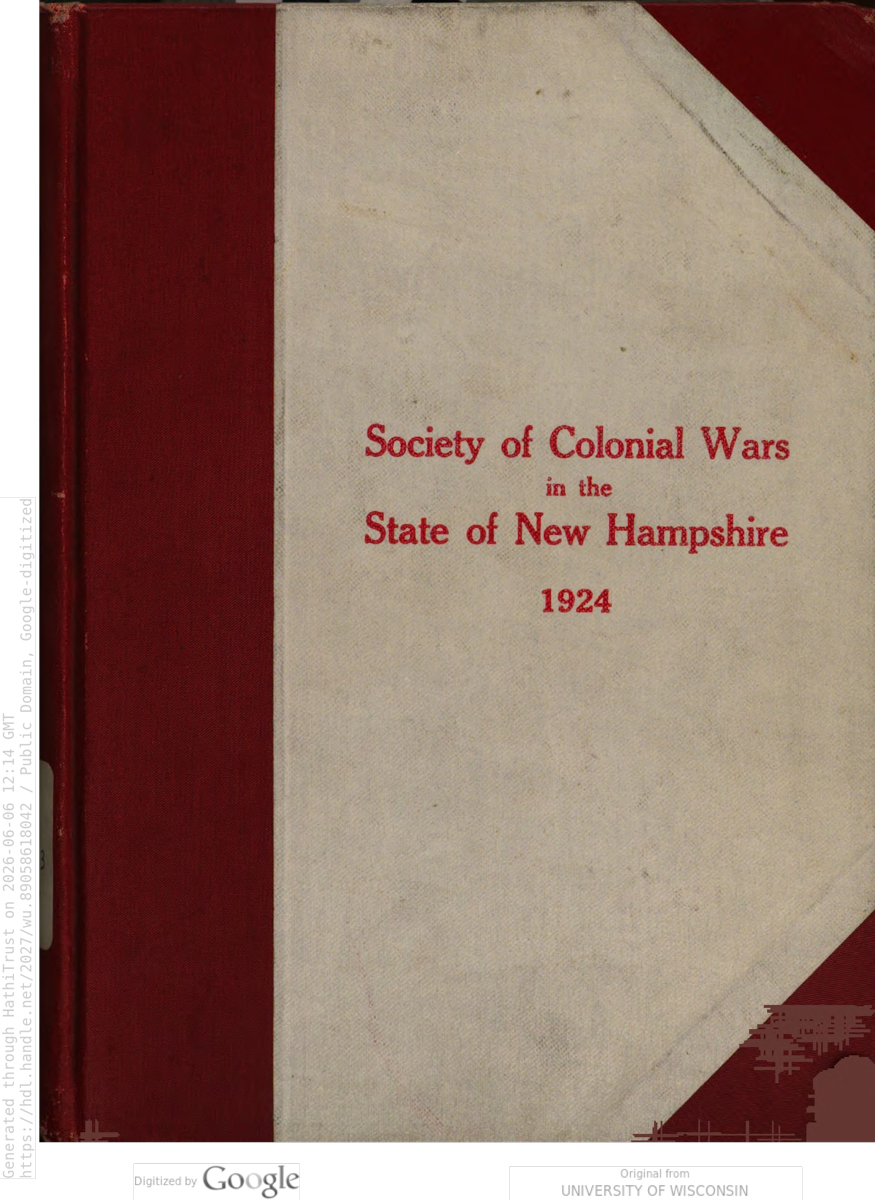
Click on image above to go to a 3rd party link to read full book
Today, these state societies continue the mission envisioned by the founders more than a century ago: to preserve historical records, commemorate significant colonial events and sites, encourage scholarly research, and foster a greater appreciation for the men and women whose efforts laid the foundations of the American nation.
Founding Milestones
- September 27, 1894 — Society organized in Concord, New Hampshire.
- September 28, 1894 — Articles of Incorporation recorded by the State of New Hampshire.
- November 12, 1894 — Charter granted by the General Society of Colonial Wars.
- December 11, 1894 — First General Court convened at the Library of the New Hampshire Historical Society in Concord.
- 1894–1900 — Henry Oakes Kent of Lancaster serves as the Society's first Governor.
Founding & Evolution
The Society of Colonial Wars in the State of New Hampshire
New Hampshire’s colonial experience was marked by nearly a century and a half of frontier conflict, military service, and civic leadership. From the earliest settlements along the Piscataqua River to the struggles of King William’s War, Queen Anne’s War, King George’s War, and the French and Indian War, generations of New Hampshire men answered the call to defend their homes, communities, and colony.
Inspired by the establishment of the General Society of Colonial Wars in 1892, a group of distinguished New Hampshire historians, attorneys, public officials, and civic leaders united to create a state society dedicated to honoring the men whose military, naval, and civil service contributed to the establishment, defense, and preservation of the American Colonies.
On September 27, 1894, these gentlemen assembled in Concord, New Hampshire, and formally organized the Society of Colonial Wars in the State of New Hampshire. The following day, September 28, 1894, the Articles of Incorporation were recorded under the laws of the State of New Hampshire. On November 12, 1894, the new organization received its charter from the General Society of Colonial Wars, formally joining the national fellowship of state societies. The Society’s first General Court convened on December 11, 1894, at the Library of the New Hampshire Historical Society in Concord.
The Articles of Incorporation clearly expressed the founders’ vision. They declared that the Society was established to perpetuate the memory, names, and deeds of those courageous men who, through military, naval, or civil service, assisted in the establishment and continuation of the American Colonies from the settlement of Jamestown in 1607 through the opening of the American Revolution in 1775. The founders further pledged to collect and preserve manuscripts, records, and historical documents relating to the colonial period; to inspire among members and their descendants the patriotic spirit of their forefathers; and to promote public respect for the principles and sacrifices that made American freedom and national unity possible.
Among the incorporators were many of New Hampshire’s leading citizens, including Henry Oakes Kent, Charles Langdon Tappan, Frederick Bacon Philbrook, Franklin Senter Frisbie, William Lithgow Willey, George Steadman Jackson, George Herbert Gross, Hosea Emery Bowen, Frederick Walter Clapp, George Henry Bowen, Frederick Lincoln Bangs, Charles McClary Bangs, and Charles Calhoun Philbrook. Their combined efforts laid the foundation for an organization that has preserved and promoted New Hampshire’s colonial heritage for more than a century.
Particularly significant among these founders was Henry Oakes Kent of Lancaster. He was an attorney, historian, and civic leader, who served as the Society’s first Governor from 1894 to 1900. Kent provided leadership during the organization’s formative years and helped establish the traditions and objectives that continue to guide the Society today. His long tenure as inaugural Governor reflects the confidence placed in him by the membership and his central role in the Society’s early development.
From its earliest years, the Society distinguished itself not merely as a hereditary organization, but as an active steward of New Hampshire’s colonial history. Annual General Courts combined scholarship, fellowship, and historical preservation. Members presented papers on colonial subjects, visited important historic sites throughout the state, and undertook projects designed to preserve and commemorate New Hampshire’s colonial past.
Among the Society’s earliest accomplishments was its sponsorship of a memorial at Fort William and Mary, now Fort Constitution, commemorating the December 1774 seizure of British military stores by New Hampshire patriots—an event occurring months before the battles of Lexington and Concord. The Society also supported preservation efforts at the Vaughan Tomb, contributed to memorials honoring colonial settlers and military leaders, and promoted public awareness of significant colonial sites including garrisons, homesteads, forts, and cemeteries throughout New Hampshire.
The vision articulated by the founders in 1894 remains the guiding principle of the Society today. Through historical preservation, education, scholarship, and fellowship, the Society of Colonial Wars in the State of New Hampshire continues to honor the legacy of those whose service and sacrifice helped shape Colonial America and laid the foundations of the United States.
The seal
The Symbolism of the Society's Seal
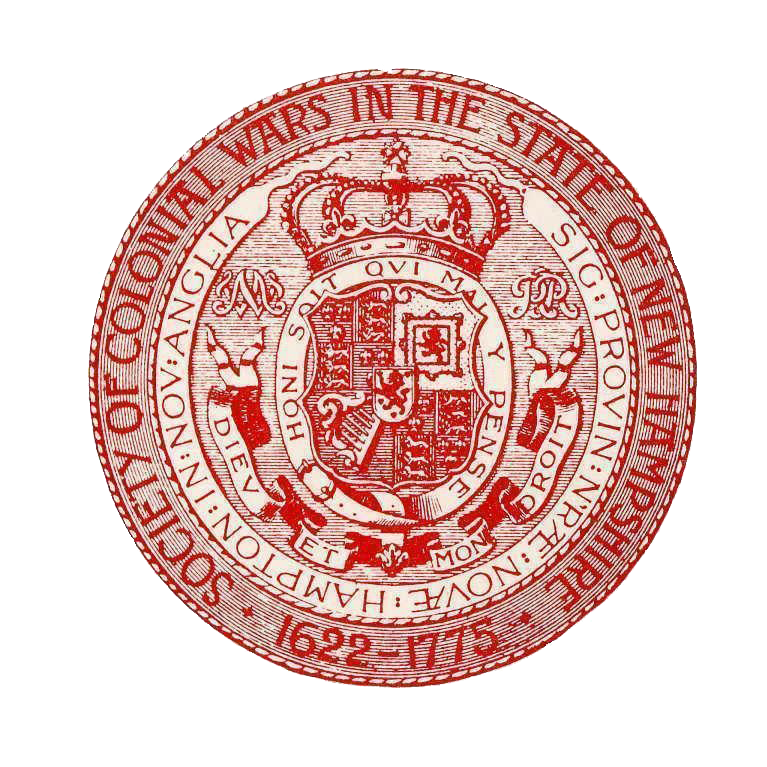
The seal of the Society of Colonial Wars in the State of New Hampshire serves as a visual link to the province’s colonial past. Drawing upon symbols associated with the Royal Province of New Hampshire, the seal reflects the historical period that the Society seeks to study, preserve, and commemorate.
At its center appears a shield bearing the arms of Nassau, surrounded by the Garter and surmounted by royal crowns. Flanking the shield are the intertwined monograms of King William III and Queen Mary II, whose reign marked an important era in New Hampshire’s colonial development. Beneath the shield appears the royal motto, *Dieu et mon Droit* (“God and my Right”), a traditional expression of sovereign authority.
The inner scroll preserves the Latin inscription of the Province of New Hampshire, while the outer ring identifies the Society itself. Together these elements symbolize the Society’s commitment to preserving the history of the men and women who shaped New Hampshire during the colonial wars and laid the foundations of the state and nation that followed.
More than a historical emblem, the seal serves as a reminder of the courage, sacrifice, and public service demonstrated by New Hampshire’s colonial settlers, soldiers, and leaders. It connects present members with a legacy that stretches from the earliest settlements of New England through the struggles that helped define North America.