
Subject of Interest
Our Founder
Henry Oakes Kent
Among the distinguished men who established the Society of Colonial Wars in the State of New Hampshire, none left a greater mark upon the Society’s formative years than Colonel Henry Oakes Kent. A soldier, attorney, journalist, banker, legislator, historian, and civic leader, Kent embodied the very ideals of public service and patriotic citizenship that the Society was founded to preserve and promote.
As the Society’s first Governor, serving from 1894 to 1900, he helped guide the organization from its inception and establish the traditions that continue to define it more than a century later.
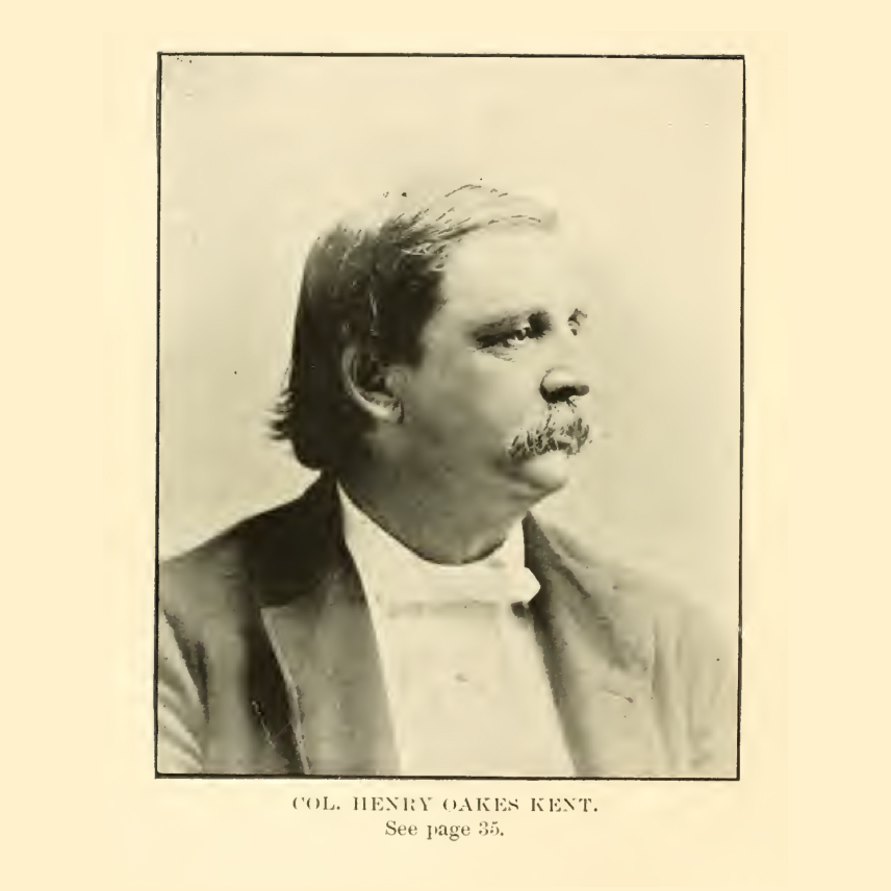
Biography
Soldier, Statesman, Historian, and Founding Governor
Henry Oakes Kent was born in Lancaster, New Hampshire, on February 3, 1834. He descended from Thomas Kent, an early settler of Gloucester, Massachusetts, who had established himself in New England before 1643. His father, Richard P. Kent, came to Lancaster in 1825 and became one of the community’s most influential and enterprising citizens. Raised amid the industrious spirit of northern New Hampshire, young Henry received his early education in the schools of Lancaster before attending Norwich University in Vermont, from which he graduated in 1854.
Following his graduation, Kent returned to Lancaster and pursued the study of law under the guidance of the Honorable Jacob Benton. After completing his legal studies, he was admitted to the New Hampshire bar in 1858. Yet the law would prove only one chapter in a life distinguished by an extraordinary breadth of interests and public service.
Possessing a keen interest in journalism and public affairs, Kent became editor and publisher of the *Coos Republican*, a position he held for twelve years. Through the newspaper he became deeply engaged in the civic life of northern New Hampshire, promoting local development and participating actively in the affairs of his community. His leadership was soon sought in numerous public endeavors. He served as moderator of Lancaster’s town meetings, clerk of the Lancaster Fire Engine Company, fire warden, treasurer of the Lancaster Bridge Company, chairman of the Coös Agricultural Society, and later chairman of the committee overseeing Soldiers’ Park. He was also active in Freemasonry and served as a warden of St. Paul’s Episcopal Church.
Kent’s influence extended well beyond his hometown. He rendered long and distinguished service to the State of New Hampshire, serving first as Assistant Clerk of the House of Representatives and later as Clerk of the House. He represented Lancaster in the legislature on multiple occasions and became one of the state’s most respected political figures. His reputation was such that he was twice nominated as the Democratic candidate for Governor of New Hampshire and was several times a candidate for the United States Congress.
During the Civil War, Kent was a devoted supporter of the Union cause and received a commission as Colonel of the 17th New Hampshire Regiment. Although the regiment was organized late in the war and did not see the extensive combat experienced by earlier units, the title of Colonel remained associated with Kent throughout the remainder of his life and reflected the respect accorded him by his contemporaries.
His talents were equally recognized at the national level. From 1885 to 1890, he served as United States Naval Officer at the Port of Boston, an important federal appointment that further demonstrated the confidence placed in his judgment and administrative abilities.
Alongside his professional and public accomplishments, Kent cultivated a deep interest in American history and genealogy. He was a member of several distinguished patriotic and hereditary organizations, including the Sons of the American Revolution, the Society of the Cincinnati, and the Society of Colonial Wars. His passion for history, combined with his gifts for leadership and organization, made him a natural choice to help establish the Society of Colonial Wars in the State of New Hampshire.
On September 27, 1894, the Society was organized in Concord, New Hampshire, and incorporated the following day. Kent was among the incorporators and was elected the Society’s first Governor. For the next six years, from 1894 to 1900, he guided the young organization through its formative period. Under his leadership, the Society embraced the objectives set forth by its founders: preserving colonial records and manuscripts, commemorating significant events and individuals from the colonial era, encouraging historical scholarship, and fostering among its members a deeper appreciation of the sacrifices and achievements of their forefathers.
The Society’s earliest activities reflected Kent’s own interests and values. Historical lectures, preservation projects, visits to colonial sites, and the commemoration of important events in New Hampshire’s colonial history became hallmarks of the organization. These efforts helped establish the Society not merely as a hereditary organization, but as an active guardian of the state’s colonial heritage.
Those who knew Kent remembered him not only for his accomplishments but for his character. A memorial published shortly after his death described him as possessing “an attractive personality and a wide knowledge of mankind and of affairs.” His life was characterized by continuous public service, intellectual curiosity, and a commitment to the welfare of his community, state, and nation.
Colonel Henry Oakes Kent died on March 21, 1909, at the age of seventy-five. By then, he had spent more than half a century in active service as a lawyer, editor, soldier, legislator, banker, historian, and civic leader. His influence extended across New Hampshire and beyond, yet perhaps one of his most enduring legacies remains the Society of Colonial Wars in the State of New Hampshire. The organization he helped found and lead continues to honor the memory of those who shaped Colonial America while preserving the history and traditions that Kent himself held so dear.
Today, more than a century after his passing, Henry Oakes Kent stands as a fitting representative of the ideals upon which the Society was founded—patriotism, service, scholarship, and stewardship of our shared historical heritage. As the Society continues its mission in the twenty-first century, it does so in the shadow of one of its most distinguished founders and first leaders.
Reference
The New Hampshire Genealogical Record. Vol. VII, No. 1 (January 1910). Dover, New Hampshire: Charles W. Tibbetts, Editor and Publisher.
“In Memoriam—Col. Henry Oakes Kent,” pp. 35–36.