Subject of Interest
Robert Rogers and His Rangers: New Hampshire’s Frontier Soldiers
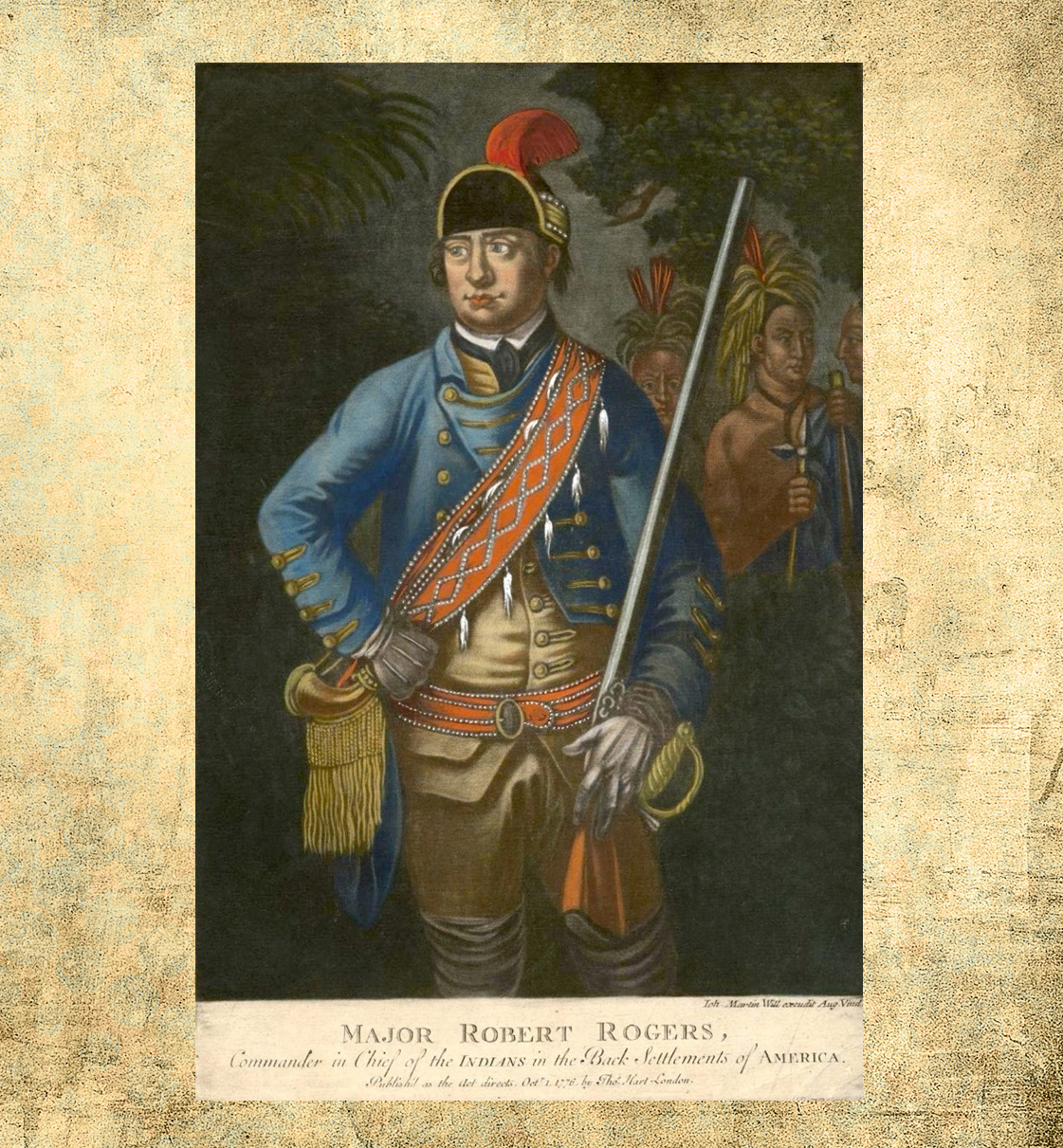
Long before the first shots of the American Revolution were fired at Lexington and Concord, the forests and waterways of northern New England had already served as a proving ground for a generation of colonial soldiers. Among the most famous of them was Robert Rogers, a New Hampshire frontiersman whose exploits during the French and Indian War earned him an international reputation and helped establish a tradition of American ranging and light infantry warfare that would endure long after his own remarkable career had ended.
Born in Methuen, Massachusetts, in 1731, Rogers was raised largely in New Hampshire. His family moved while he was still a boy to the frontier settlement known as Great Meadow, (near present-day Concord), in an area later associated with Dunbarton. It was there, on the unsettled edge of British North America, that Rogers acquired the skills that would define his military career. Rogers became uniquely familiar with hunting, tracking, waterways, winter travel, and the geography of the northern frontier.
His youth coincided with a violent period in New Hampshire’s colonial history. During King George’s War in the 1740s, settlements on the New England frontier lived under the threat of attack from French forces and their Native allies. Rogers served while still young in the New Hampshire militia, gaining experience in frontier defense that differed considerably from conventional European warfare.
When renewed conflict between Britain and France erupted in North America in the 1750s, Rogers found the arena in which his particular abilities would make him famous.
In 1755, Rogers recruited men for military service and received a captain’s commission in a New Hampshire provincial regiment. Operating principally in the region of Lake George, Lake Champlain, Crown Point, and Fort Carillon (later known as Ticonderoga), Rogers demonstrated an unusual talent for reconnaissance and quick strikes. He and his men traveled deep into contested territory, observing French positions, estimating troop strength, capturing prisoners, and returning with intelligence that conventional British forces often could not obtain.
His effectiveness attracted the attention of British commanders. In March 1756, Rogers was authorized to raise an independent company of rangers specifically for scouting and intelligence duties. Other companies followed, and by 1758 Rogers commanded a substantial ranger corps. Rogers did not invent ranging; the practice had a long history on the North American frontier brought forth largely by its native inhabitants.
A Different Kind of Soldier
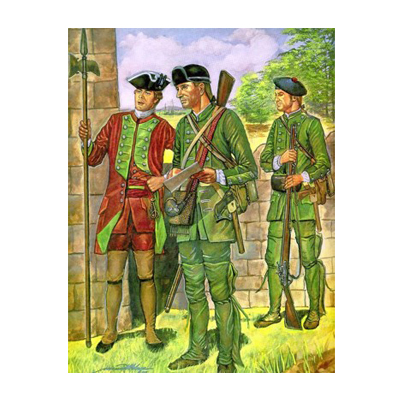
Rogers’ Rangers looked and operated differently from the European soldiers alongside whom they served.
The traditional British soldier was trained to fight as part of a disciplined formation. Rogers’ men were expected to function independently in forests, mountains, and swamps where conventional formations were often impractical. They learned to travel rapidly and quietly, conceal themselves, scout enemy positions, conduct ambushes, survive for extended periods with limited supplies, and fight effectively in small groups.
These guerrilla tactics were shaped by generations of warfare on the North American frontier and were heavily influenced by Indigenous methods of movement and combat. The New Hampshire Historical Society notes that Rogers’ fighting techniques were strongly influenced by methods he learned from the Abenaki.
Rogers eventually committed these methods to writing in his famous Rules of Ranging. The principles emphasized preparedness, security on the march, careful reconnaissance, concealment, disciplined movement, and avoiding predictable behavior.
The Rangers consequently became invaluable to British commanders. They went where ordinary troops often could not…serving as scouts, raiders, skirmishers, and intelligence gatherers. Rogers’ patrols penetrated the country surrounding the French strongholds at Crown Point and Ticonderoga, sometimes approaching closely enough to obtain detailed information about enemy defenses.
In January 1757, Rogers and approximately 70 Rangers fought a desperate engagement near Ticonderoga after encountering a much larger French force. Rogers was wounded, and his command suffered significant casualties, but the Rangers managed to avoid complete destruction. The following year another bloody encounter occurred near Ticonderoga, one of the famous “Battles on Snowshoes”, again demonstrating both the effectiveness and terrible risks of deep reconnaissance operations.
A New Hampshire Company
For New Hampshire, Rogers’ Rangers have particular significance because many of the men who joined Rogers came from the same frontier communities that had shaped him. One of the most famous of these was a young New Hampshire woodsman named John Stark.
Long before Stark became the Revolutionary War general remembered for Bunker Hill and Bennington, he served as an officer in Rogers’ Rangers. The experience exposed Stark to reconnaissance, irregular warfare, wilderness movement, and independent command. These skills would prove useful when another war arrived less than two decades later. The New Hampshire Historical Society specifically identifies Rogers and Stark as two of the colony’s most prominent military figures to emerge from the French and Indian War.
The Rangers therefore occupy an interesting place between New Hampshire’s colonial and Revolutionary histories. They belonged unmistakably to the British Empire, with Rogers and his men fighting for the Crown against France. Yet among the provincial soldiers who gained military experience during these campaigns were men who would later turn those skills against British forces during the struggle for American independence. Thus, the French and Indian War served as training for an entire generation of Americans.
The Raid on Saint-Francis
No episode in Rogers’ career became more famous or controversial than his 1759 expedition against the Abenaki community of Saint-Francis (Odanak) in present-day Quebec, Canada.
British authorities regarded Saint-Francis as a base from which raids had been launched against New England frontier settlements. Rogers was ordered to lead a force deep into enemy territory and attack the community. The Rangers traveled an extraordinary distance through hostile country and struck Saint-Francis in October 1759. Rogers reported destroying the settlement and inflicting heavy casualties before beginning an arduous retreat toward New England.
Short of food and hotly pursued by the enemy, Rogers divided his starving force into smaller groups and directed them toward the Connecticut River. They expected provisions to be waiting at Fort Wentworth, in what is now northern New Hampshire. When the exhausted Rangers arrived, however, the expected supplies were unavailable.
Rogers then traveled down the Connecticut River seeking assistance from Fort at Number 4, (present-day Charlestown, New Hampshire), so that food could be carried back to his men. Barely able to walk from starvation, Rogers managed to load supplies from the fort and boated back up the river to personally deliver the food to the remnants of his unit. The episode tied one of the most famous Ranger expeditions directly to the New Hampshire frontier.
New Hampshire and the War for North America
Although relatively little of the major fighting occurred within New Hampshire itself, the colony contributed heavily to Britain’s war effort in the French and Indian War. New Hampshire soldiers campaigned throughout the Lake Champlain and Hudson River corridors and participated in operations connected with Crown Point, Ticonderoga, Quebec, and Montreal. New Hampshire troops also helped construct the Crown Point Road connecting Fort at Number 4 with the newly captured British position at Crown Point.
By the end of the French and Indian War, Rogers’ Rangers had operated from the forests of New England and New York to Canada and ultimately into the western Great Lakes. Rogers himself participated in the final campaigns that broke French power in Canada and was subsequently dispatched westward to receive the surrender of French posts, including Detroit.
A Complicated Legacy
Rogers’ later life was considerably less triumphant. He struggled financially. He traveled to England and became involved in ambitious schemes for western exploration and eventually returned to North America. When the American Revolution began, his position became particularly complicated.
Unlike John Stark and many other veterans of the French and Indian War, Rogers did not ultimately join the Patriot cause. He remained loyal to the Crown and later raised Loyalist troops during the Revolution.
The men who had fought together against France in the 1750s did not necessarily choose the same side twenty years later. Former comrades became enemies. Loyalty to one’s colony, loyalty to the Crown, personal ambition and economic necessity often pulled individuals in very different directions. Rogers belonged to the generation that helped Britain secure an empire in North America and then lived long enough to see much of that same empire rebel against the Crown.
The Ranger Legacy
Whatever judgment one makes about Robert Rogers himself, the military legacy associated with Rogers’ Rangers is substantial. He helped formalize a distinctly North American approach to scouting and irregular warfare. His Rangers demonstrated the importance of intelligence, mobility, individual initiative, concealment, surprise, and survival.
The National Park Service places Rogers’ Rangers within the early American tradition of frontier scouts and raiders whose methods helped establish a continuing tradition of irregular warfare.
Robert Rogers grew up on the New Hampshire frontier, and he recruited New Hampshire men. John Stark and other future Revolutionary soldiers learned the realities of war in the same northern wilderness, and the colony itself committed substantial manpower to a conflict that permanently altered both North America and New Hampshire
P. Stacey, “Rogers (Rodgers), Robert,” Dictionary of Canadian Biography, vol. IV.
Robert Rogers, Journals of Major Robert Rogers (London, 1765).
Stephen Brumwell. White Devil: A True Story of War, Savagery, and Vengeance in Colonial America (Da Capo Press, 2005)
John F. Ross. War on the Run: The Epic Story of Robert Rogers and the Conquest of America’s First Frontier. (Bantam, 2011).