Subject of Interest
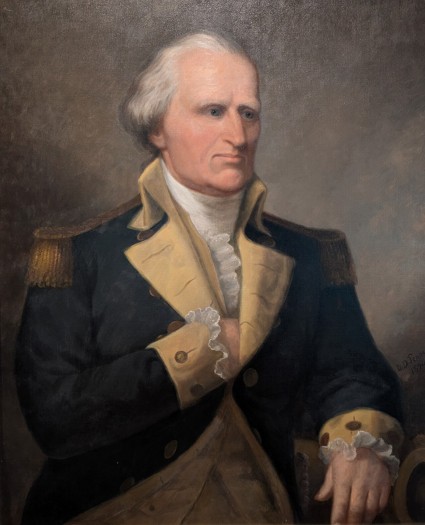
John Stark Frontier Soldier and Revolutionary Hero
John Stark was born in Londonderry, New Hampshire (present-day Derry) on August 28, 1728. Although he is best remembered as one of New Hampshire’s most distinguished Revolutionary War generals, Stark’s character and leadership were forged during the colonial period on the northern frontier. His experiences during the French and Indian War, as well as his remarkable captivity among the Abenaki, helped shape the man who would later become one of America’s most celebrated military leaders.
One of the most remarkable episodes of Stark’s early life occurred on April 28, 1752. While on a hunting and trapping expedition along the Baker River, a tributary of the Pemigewasset River, Stark was captured by Abenaki warriors and taken to Canada. Along with fellow prisoner Amos Eastman, he was forced to run a gauntlet of warriors armed with sticks. Rather than submit, Stark seized a stick from the first warrior and fought back, surprising his captors with his courage and determination. The Abenaki chief was so impressed by his actions that Stark was adopted into the tribe, where he remained through the winter.
The following spring, a government agent from the Province of Massachusetts Bay negotiated the release of Stark and Eastman. Stark’s ransom was paid in the amount of 103 Spanish dollars, while Eastman’s ransom cost 60 dollars. Both men safely returned to New Hampshire.
Stark later served as a second lieutenant under Major Robert Rogers during the French and Indian War. His brother, William Stark, served alongside him. As a member of the renowned Rogers’ Rangers, Stark gained valuable combat experience and developed an intimate knowledge of the northern frontier.
During his service with the Rangers, Stark participated in numerous scouting and military operations. In 1755, he took part in the campaign that resulted in the defeat of Baron Dieskau. He later served as both a lieutenant and captain under Rogers. In January 1757, after a day of fierce fighting and an all-night march, Stark traveled forty miles through deep snow to bring assistance to wounded comrades. He also participated in General Amherst’s campaigns against Ticonderoga and Crown Point in 1759.
Following these campaigns, Stark returned to central New Hampshire, where he helped establish a new township originally known as Starksville, later renamed Dunbarton.
One interesting story from this period concerns General Jeffery Amherst’s 1759 expedition against the Abenaki village of St. Francis in Quebec. Rogers’ Rangers were ordered to undertake the mission, and Stark, who was second-in-command of the ranger companies, reportedly declined to accompany the attacking force. According to tradition, he did so out of respect for the Abenaki family who had adopted him during his captivity years earlier. Instead, he returned to New Hampshire and to his wife, whom he had married the previous year.
These frontier experiences instilled in Stark a courage, resilience, and understanding of wilderness warfare that would later serve him well during the American Revolution. Long before his celebrated service at Bennington and his famous declaration, “Live Free or Die,” Stark embodied the resourcefulness and determination of the colonial settlers who defended New Hampshire’s frontier. His life stands as a remarkable link between the colonial struggles of the eighteenth century and the birth of the American nation.
Sources: John Stark Papers; New Hampshire Historical Society; contemporary biographical accounts; Encyclopedia.com